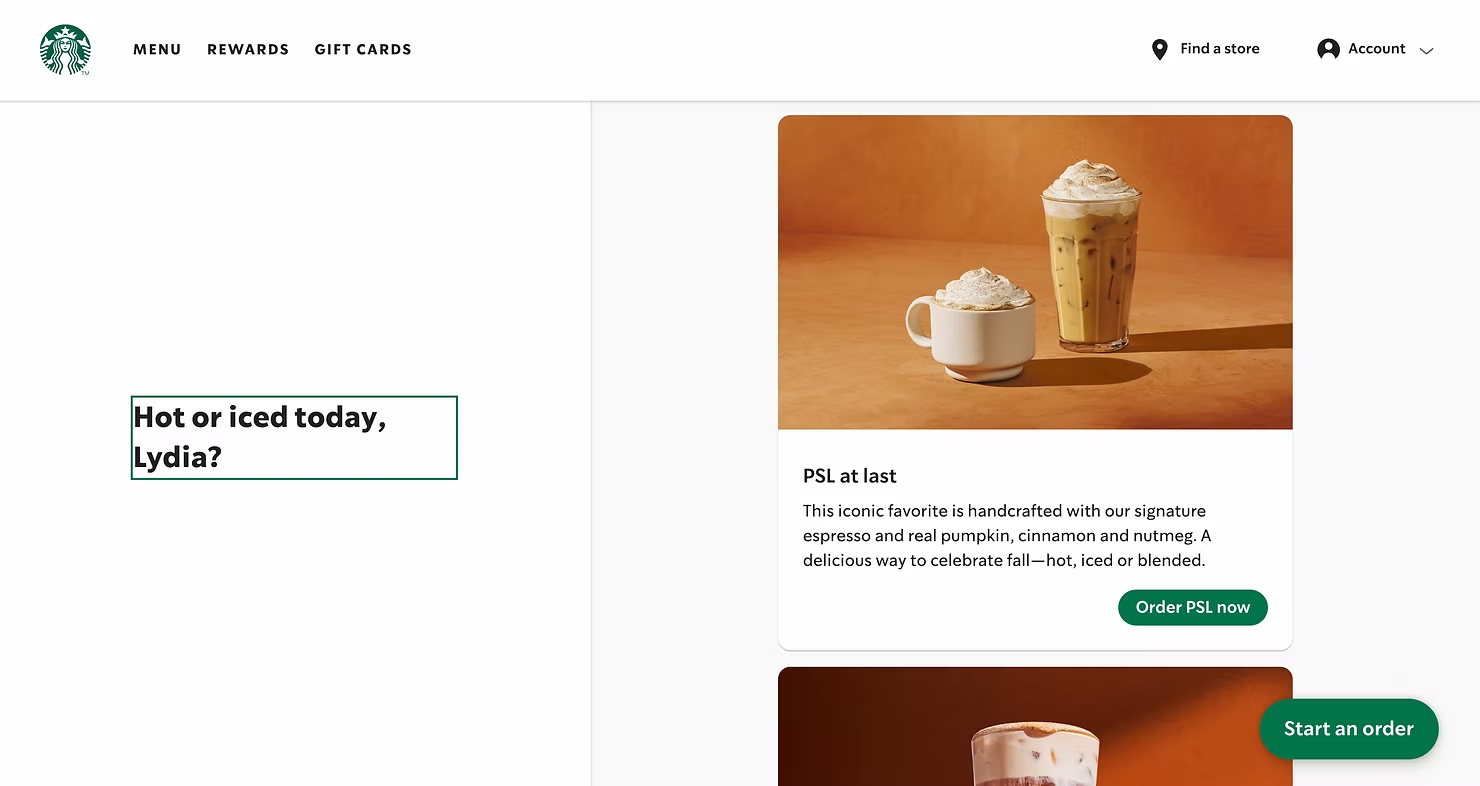
Does your favorite app know your name? Or even your favorite coffee order and what time of day you typically buy it? Or maybe, you have been researching a new pair of sneakers. Then you begin to notice that every ad you see online contains Nike or Hoka's best deals! Is this type of personalization scary? Or is it convenient? I would say that the idea of companies handling our personal information does sound daunting. But, at the same time, it is extremely handy as a consumer. The example depicted above is a real-time image of my Starbucks rewards page. Notice that it calls me by name and asks if I will be ordering a hot or cold drink. It knows my preferences when mobile ordering! The page also showcases their new Fall flavored drinks, which I frequent during the Autumn season! All of this falls into the category of big bata. Let's dive deeper!
Author, Rajat Paharia, describes big data as "explosion in the size, amount, and form of information available around any one individual, organization, or event. It comes from an increasingly wide variety of sources; is assembled in a variety of forms, some structured and processed and some unstructured and unprocessed; and is present in heretofore unimagined quantities," within his book Loyalty 3.0. (Paharia, 2013) This has evolved significantly in recent years as companies traditionally used to ask for your name, address, e-mail, or phone number. Now, everything we do is mediated by technology that is able to store and share data to better cater and market to consumers and employees. Some examples of these data points that Paharia mentions are GPS locations, mobile phone usage, online shopping patters, social networks, connected devices and many more. (Paharia, 2013) Big data holds to these four characteristics:
1) It is unlikely to be in only one place
2) It is unlikely to be owned or controlled by one organization
3) It is not managed through traditional "structured" database tools
4) It is GIGANTIC (hence the name "big data")
(Paharia, 2013)
In other words, big data can be summarized and recognized through the three V's: volume, velocity, and variety. (Paharia, 2013) Because of each of these components, big data gives businesses the ability to know what you do, where/when you do it, and what you like. Through this, companies have the advantage of interacting with consumers as well as employees. They can listen and react. The accumulation of all of these things is how we reach the Loyalty 3.0 model. Because big data essentially creates personalization, employees and customers are going to automatically feel more engaged with a company, creating a stronger sense of loyalty.
To a Christian in the world of marketing, big data can seem slightly frightening. Proverbs 18:15 says "“The heart of the discerning acquires knowledge, for the ears of the wise seek it out.” (NIV Bible, 2015) The book of Proverbs is telling us that the gaining of knowledge is a gift. Essentially, this is the purpose of big data. This verse tells us that acquiring wisdom without discernment and moral grounding is where the danger begins. No matter which way you feel about big data, it is truly a business-defining tactic in our society today and has changed the marketing game in many ways.
NIV Bible. (2015). Hodder & Stoughton.
Rajat Paharia. (2013). Loyalty 3.0 : how big data and gamification are revolutionizing customer and employee engagement. Mcgraw-Hill Education.